
Understanding What Actually Determines Heating Costs
The amount of heat your home requires depends primarily on the difference between indoor and outdoor temperatures, combined with the building's insulation, air leakage, wind exposure, and other environmental conditions.
Most homeowners maintain indoor temperatures somewhere around 68–72°F during winter.
Consider a home maintained at 70°F when the outdoor temperature is 35°F. The difference is 35 degrees. Lowering the indoor temperature to 66°F reduces that difference to 31 degrees.
That does reduce the instantaneous rate of heat loss, but only modestly. And because the home takes time to cool down, the actual reduction over a typical daytime setback period is even smaller.
Meanwhile, outdoor temperatures, wind, solar exposure, and changing weather conditions continue to influence the heating load throughout the day.
In a modern, well-insulated home, an eight-hour setback may not even allow the indoor temperature to reach the lower thermostat setting until shortly before recovery begins.
The potential savings are limited from the beginning.
Heat Pumps: Where Setbacks Can Become More Expensive
Heat pumps operate differently from conventional electric resistance heating.
Rather than converting electricity directly into heat, they move heat from outdoors into the home. Under favorable operating conditions, a heat pump can deliver several units of heat for every unit of electrical energy consumed.
Electric auxiliary heat, however, operates at approximately one unit of heat per unit of electricity.
When a thermostat calls for a large temperature increase, many conventional heat-pump systems respond by activating auxiliary electric resistance heating to accelerate recovery.
That additional heating capacity comes at a substantially higher operating cost.
The heat pump may have consumed slightly less electricity during the setback period, only to surrender those savings when the auxiliary heater operates.
This is why Fenwick HVAC recommends avoiding routine winter temperature setbacks on residential heat pumps.
What Does a Thermostat Setback Actually Cost?
Let's compare three operating strategies for a typical residential heat pump in a modern, energy-code-compliant home.
For our example, we'll use:
- A 3-ton, 16-SEER-class heat pump
- A 15 kW auxiliary electric heating system
- A constant outdoor temperature of 35°F
- A normal indoor temperature of 70°F
- An eight-hour daytime setback to 62°F
- Delaware residential electricity at 18.7 cents per kWh
In the auxiliary-heating scenario, electric resistance heat operates for 45 minutes during recovery.
Estimated Daily Heating Costs
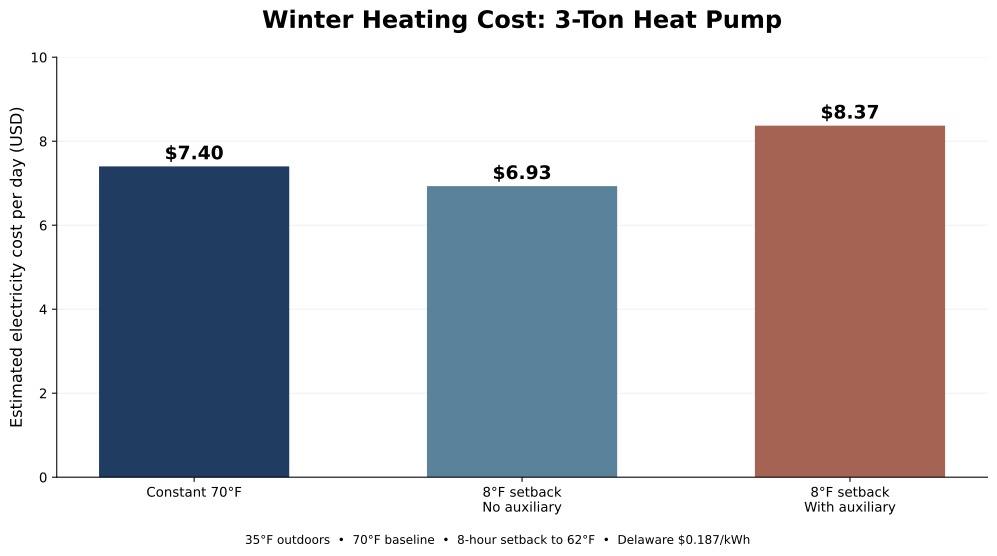
| Heating strategy | Daily cost | Difference from constant | 30-day difference |
|---|---|---|---|
| Constant 70°F | $7.40 | Baseline | Baseline |
| 8°F setback, no auxiliary heat | $6.93 | −6.3% | −$14.03 |
| 8°F setback, with auxiliary heat | $8.37 | +13.2% | +$29.10 |
Illustrative engineering model using a scaled residential building heat-load profile and an assumed heat-pump operating COP of 2.8. Actual results vary with equipment, controls, and building conditions. The electricity rate is based on August 2026 Delaware residential averages reported by the U.S. Energy Information Administration.
What the Numbers Tell Us
Even when auxiliary heat is completely avoided, the setback saves just 47 cents per day in this example.
And those savings come with a substantial disadvantage: the home requires several hours to return to its normal temperature.
When auxiliary heat operates for 45 minutes, the setback becomes 97 cents per day more expensive than maintaining a steady temperature.
Over 30 similar heating days, that represents approximately $29 in additional electricity costs rather than any savings at all.
In other words, you can spend more money to be less comfortable.
Comfort Is About More Than Air Temperature
One of the greatest problems with thermostat setbacks is that our comfort depends on considerably more than the temperature of the air around us.
Walls, floors, ceilings, furniture, and other surfaces absorb and release heat. When the indoor temperature is reduced for several hours, these surfaces gradually cool as well.
Consider standing near a campfire on a cold evening.
Even when the surrounding air remains cold, you feel comfortable facing the fire because radiant heat warms your body directly.
Now imagine the opposite effect inside your home.
After a prolonged thermostat setback, the heating system may restore the air temperature to 70°F, but the surrounding walls, floors, and furnishings can remain noticeably colder.
Those surfaces absorb radiant heat from your body, leaving you feeling chilly despite the thermostat indicating a comfortable temperature.
Restoring true thermal comfort requires warming the building's interior surfaces, not just the air.
That takes additional time.
A thermostat reading of 70°F doesn't guarantee that a home feels like 70°F.
The Hidden Cost of Recovery Time
Thermostat setback recommendations frequently emphasize the hours spent at a reduced temperature while overlooking the recovery period.
During recovery, the heating system may operate continuously rather than cycling normally.
A heat pump recovering without auxiliary heat can take hours to restore the indoor temperature, especially when outdoor temperatures are low.
The homeowner then faces two choices:
Accept an extended period of reduced comfort, or use auxiliary heat to accelerate recovery at a significantly higher cost.
Neither is particularly attractive when the potential financial benefit is so small.
And in many homes, the very times occupants want the greatest comfort—waking up in the morning or returning home in the evening—are the times the heating system is struggling to recover.
The Effect on the Electrical Grid
There is another consideration that extends beyond the individual home.
When large numbers of programmable thermostats begin their morning recovery cycles simultaneously, heating demand can increase at precisely the times electrical demand is already elevated.
In homes with heat pumps, the activation of auxiliary electric heating can substantially increase instantaneous electrical consumption.
Consider a home with a 3-ton heat pump and a 15 kW auxiliary heater. When both operate together, the electrical demand can exceed 18 kW.
Now consider thousands of homes doing the same thing during morning recovery.
Instead of distributing heating demand more evenly throughout the day, synchronized thermostat setbacks can contribute to concentrated periods of high electricity demand.
Peak demand influences the generating and distribution capacity utilities must maintain, and those infrastructure costs ultimately affect consumers.
Are There Situations Where Setbacks Make Sense?
Certainly.
Thermostat setbacks can be useful in buildings with substantial differences between occupied and unoccupied periods.
Commercial offices, schools, warehouses, and industrial facilities may remain unoccupied for extended periods. Some also have ventilation and other operating loads that can be reduced significantly when the building is empty.
Poorly insulated buildings can also experience greater reductions in heat loss during setbacks, although their recovery requirements may be substantial.
Extended vacancies are another matter entirely. Lowering the temperature of an unoccupied home for days or weeks can provide meaningful energy savings, provided adequate freeze protection is maintained.
These situations are fundamentally different from repeatedly adjusting the thermostat in a normally occupied residence.
Our Recommendation: Set It and Forget It
For most occupied residential homes during the winter, Fenwick HVAC recommends maintaining a consistent, comfortable indoor temperature.
For homes with heat pumps, our recommendation is particularly strong: avoid routine thermostat setbacks that can trigger auxiliary electric heating.
Choose a temperature that feels comfortable and allow your heating system to maintain it.
A properly installed and maintained heat pump is designed to operate efficiently without requiring the homeowner to continually adjust the thermostat.
Our position is simple: The small theoretical savings associated with daily winter setbacks are generally not worth the discomfort, prolonged recovery, and potential increase in operating costs.
Ron Popeil said it best: “Set it and forget it!”
When it comes to your winter thermostat, we couldn't agree more.
Fenwick HVAC provides residential and commercial heating, air conditioning, refrigeration, and building automation services throughout Sussex County, Delaware, and Worcester and Wicomico counties, Maryland. We believe informed customers make better decisions, and our recommendations prioritize comfort, reliability, efficiency, and long-term value.